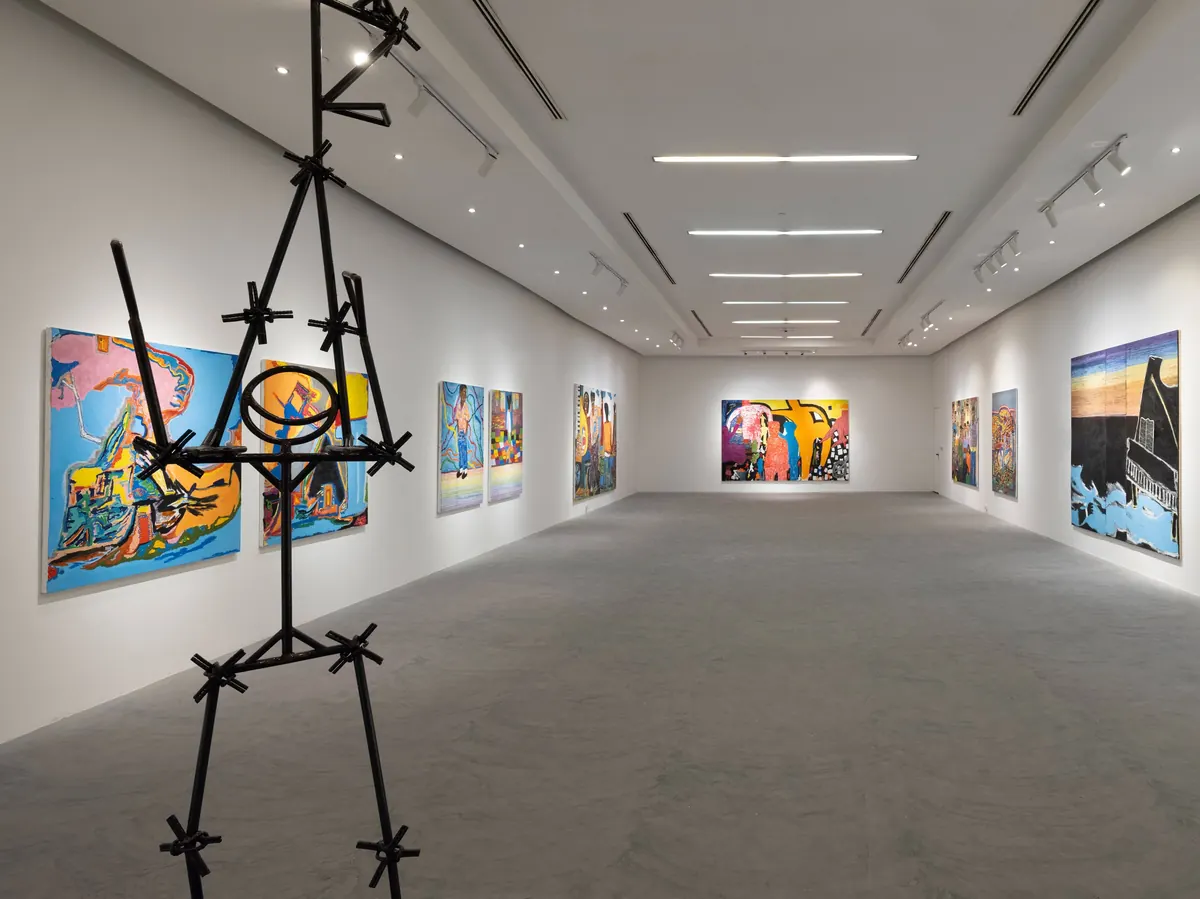
Son of Kafui is Gabriel Selassie Tsagli's first solo exhibition in Ghana, curated by Marina Paulenka for Gallery 1957 in Accra. It grew out of his five-month residency with the gallery, during which Paulenka mentored him as a new body of work took shape. Of the many paintings he made there, nineteen were selected for the exhibition, shown with one iron sculpture. Kafui, meaning love, was the name of the painter's late mother. Born in Accra in 1988 and raised between Ghana and Germany, Tsagli returned to Accra in 2025. The works move between his upbringing and his future through the women who shaped his life: the grandmothers and aunties who raised him, the mother he lost and the daughter he is now raising. Showing the work first in Accra, before any other audience, was itself the curatorial position.
Son of Kafui begins where all serious work begins: in the body’s memory of a specific place, a specific woman, a specific quality of light that falls through a particular doorway and does not leave. The title names this directly and tenderly. Kafui, meaning love or son of God’s own, was the name of Selassie’s late mother, and this exhibition, his first solo presentation in Ghana, is a homecoming conceived through grief and carried to completion through something that resembles, more than anything else, devotion.
He grew up in Accra, raised by grandmothers and aunties in a family compound in Dansoman whose rhythms and textures have never left him, then moved to Germany at eleven, crossing into a cold that must have felt like a different kind of distance even as it closed another. His mother too lived between the two countries, her life distributed across Ghana and Germany the way that the lives of so many in the African diaspora are distributed, belonging fully to neither place and drawing sustenance from both. He returned to Accra last year, and it was here, back inside the city that first formed him, that he made the work now on these walls. And he made it holding two things simultaneously: the loss of the woman he came from, and the existence of the daughter he is now raising, her whole life still ahead of her. To stand between those two facts, to be son and father at once, grieving backward and responsible forward, is the emotional position from which every painting in this show was made. As Selassie has said, a lot of his freedom comes from grief. His mother’s death taught him simply to do things, to not wait, to not avoid. He tries not to avoid crying, anger, chaos, or beauty. All of it, he believes, is necessary for balance, in the self and in the painting.
Belonging is not a theme Selassie has chosen for this exhibition. It is the condition he has lived in his own body for more than thirty years, and the paintings are the most honest record he knows how to make of what that costs and what it gives.
This biographical truth is inseparable from his painterly one. Selassie works with multiple tools, moving between instruments that produce soft undertones and others that drag rough, tactile surfaces into being, some pressing colour into the weave of the canvas until it breathes quietly, others leaving marks you can almost feel from across the room. Paint applied directly from the tube adds another register entirely, a density and physicality that makes the surface touchable, insisting on its own material existence. Displaced into a country whose language and logic he had to learn from the ground up, Selassie was forced to build his own philosophy of the world, and art became the primary instrument of that construction, more rigorous and more personal than any school or book could have offered. He paints from inside the moment rather than toward a conclusion already reached, trusting that each mark carries him somewhere he could not have seen from where he was standing. In the studio he works in silence, listening to the street outside, to how someone might be sheltering, to how animals move through the heat, to the natural sounds of a place that have always fed his sense of colour and rhythm. Colour does not fill form here but generates it, outlines pulse with their own charge independent of the bodies they trace, and line moves across the surface with the freedom of someone thinking out loud. Dense, accumulated marks build figures from texture rather than contour, so that a person emerges from the paint the way a person emerges from memory, gradually, incompletely, with a vividness that has nothing to do with precision.
These surfaces are built slowly, over long stretches of time. Selassie rarely finishes one painting before beginning another; he moves between several canvases at once, letting each evolve across weeks and months, every return adding new gestures, corrections, textures, traces of earlier decisions. Mistakes are never concealed. They are absorbed into the work, revised in the open until the correction itself becomes another layer of meaning, because for Selassie, correcting a mistake is far more interesting than painting without one. What remains on the canvas is not a fixed image but a record of lived time, of revision, reflection and care, the way a relationship carries the visible trace of every encounter. The layering, then, is not a technique so much as a philosophy: life itself is layered, and every person he encounters carries within them everything they have been through to arrive at the moment of meeting. He does not want to keep that depth out of the paintings.
And within the same canvas, figuration can give way without warning to passages of pure abstraction, a city dissolving into gesture, a body opening into colour field, as if the most intense emotional states simply exceed what representation can hold. He hopes this confuses the viewer productively, opening a space where chaos and beauty are not opposites but the same force moving at different speeds, where the audience is invited to find in themselves the same kind of balance the paintings are always working toward.
Selassie speaks of colour the way a musician speaks of composition: as something that can be calculated, structured, theorised, and yet, like jazz, always open to invention that no theory could have predicted. Every day, he believes, is a different note. He returns often to a correspondence that structures this thinking: seven colours in the spectrum, seven notes in the scale, seven chakras in the body, as if colour, sound and spirit were a single system perceived through different senses, and a painting could be tuned the way an instrument, or a body, is tuned. Orange and blue carry a private meaning throughout the work, orange the colour of doing, of action in the world, blue the colour of speaking, of finding the word for what the body already knows. They sit far apart in the spectrum, and it is precisely that distance, the same productive tension that red and purple carry, that gives the paintings their particular depth, two forces refusing to collapse into each other, generating something more alive in the space between them.
The figures that populate these canvases move between registers of intimacy and distance. Some are specific people, known and loved, painted with the kind of attention that only comes from long proximity, their presence in paint as irreplaceable as it is in life. Among them, his mother appears blue against pure black, her figure barely separating itself from the darkness, present through paint alone, as if being called back into visibility. Other figures are not portraits of the living or the dead. They are dreams, moments, memories of how things used to feel, compositions that arrange themselves the way old photographs do in the mind, half-remembered, luminous, more true to an emotional reality than any document could be. Around all of them, smaller figures swarm in near abstraction, the anonymous pulse of community, the city as organism rather than backdrop. And in one of the most expansive works in the show, a piano meets water and a body, the boundary between instrument, sea, and human form softening into a single sustained note that seems to ask whether music and grief and love are not, finally, the same thing.
Son of Kafui is this artist’s first solo exhibition in Ghana, and showing here, on home ground, before any other audience, is itself a position, a choice to be judged first by the city and the people who formed him. What the work asks of anyone who stands before it is not interpretation but presence, not the comfort of recognition but the willingness to stay long enough to be moved, to let something operate on the body before the mind has organised its response, to return, even briefly, to a way of knowing that precedes the habit of knowing.
As Selassie himself has said: we are not building new worlds. We are building new words to allow the old to pass perfectly. Son of Kafui is such a word, spoken in colour and layered paint, addressed to a mother, a daughter, a city, and anyone willing to listen with their whole self.