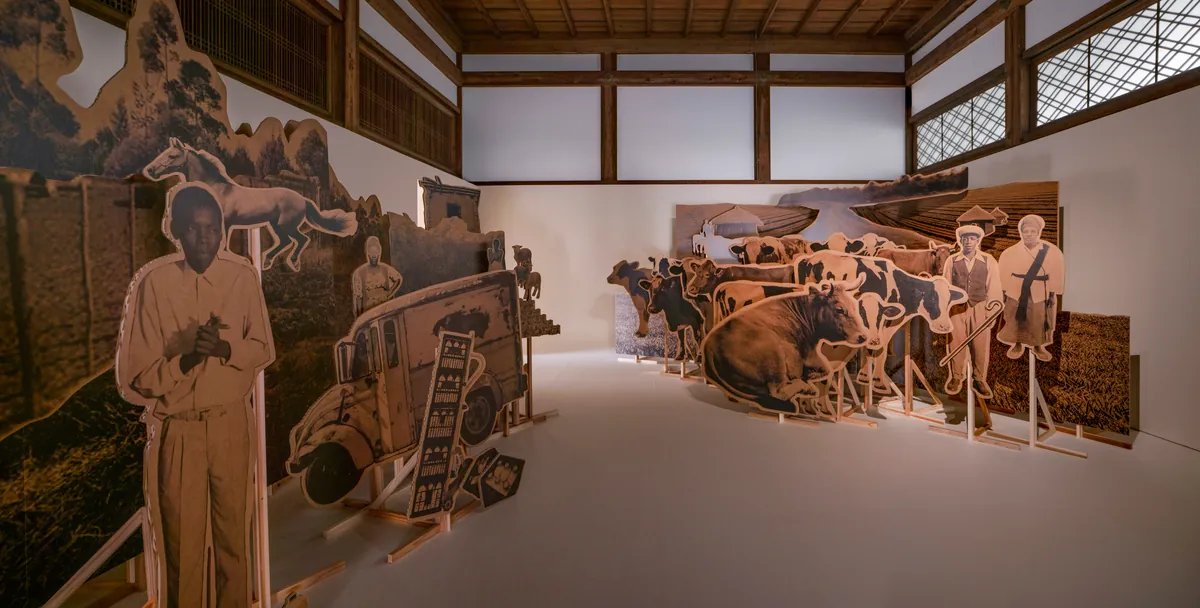
Rehearsal of Memory was Lebohang Kganye's first major exhibition in Japan, curated by Marina Paulenka for KYOTOGRAPHIE 2026 and its South Africa in Focus programme, in the O-genkan of Higashi Honganji in Kyoto. Four major bodies of work (staged photographs, cut-out silhouettes, diorama lightboxes and monumental patchwork figures) were set in a scenography by Hiromitsu Konishi (miso). The exhibition asked how families and nations are held together by what is missing: a mother's photographs restaged by her daughter, a family name that means light, relatives who survive as images. It continued a collaboration that began with Le Sale ka Kgotso, the installation Kganye made for Fotografiska Berlin in 2025, also curated by Paulenka.
Memory is a gesture repeated, a shadow returning across time; it rehearses itself in light, in paper, in wood.
In Rehearsal of Memory, Lebohang Kganye presents a constellation of four major bodies of work that explore how families, nations, and identities are shaped by absence, inheritance, and imagination. Across photography, cut-out silhouettes, diorama lightboxes, patchwork fabric, and sculptural interventions, the exhibition transforms personal archives into immersive, living spaces where the past and present coexist.
Visitors enter a layered narrative in which South African histories, family stories, and postcolonial realities converge. Kganye repeatedly positions herself inside her own archive, inhabiting the silhouettes of ancestors, wearing her mother’s clothes, or appearing as a spectral double. In doing so, she rejects the distance between storyteller and story, making memory itself a fragile, performative practice.
Installed within Higashi Hongan-ji, one of Kyoto’s most significant wooden temple complexes, the exhibition enters into dialogue with centuries of craftsmanship and the poetry of light filtered through wood and paper. Shadows, silhouettes, and material presence echo Japanese aesthetics, recalling the subtle gradations praised by Jun’ichirō Tanizaki in In Praise of Shadows. Here, memory becomes architecture, and history unfolds like a rehearsal: repeated, imagined, and experienced anew. Kganye invites viewers not merely to observe, but to inhabit memory, feeling its rhythms, gaps, and resonances, and recognizing how the past continues to live within the present.
Four bodies of work
Ke Lefa Laka: Her-story 2013
Two years after her mother’s death, Kganye revisited family photo albums and the clothing her mother had worn, now resting quietly in the wardrobe. She retraced the locations of the original photographs, restaging the scenes and merging her own image with her mother’s through photomontage. The series becomes a living dialogue between generations, a rehearsal of memory that acknowledges absence, continuity, and the personal act of remembering.
Mohlokomedi wa Tora 2018
This large-scale installation explores the meaning of the artist’s family name, Kganye or Khanye, which signifies “light” in Southern African languages. Life-size cardboard silhouettes form labyrinthine passages, evoking township streets and ancestral lineages. Each entrance represents a branch of the family, while the structure itself guides visitors through light and shadow, reflecting the refracted paths of history, identity, and remembrance.
Mosebetsi wa Dirithi 2022–2023
Monumental patchwork figures emerge from archival family photographs, reconstructed in cotton twill to form a gallery of honour for relatives whose lives shaped the artist’s biography. The figures are both present and spectral, reflecting memory’s incompleteness. Through these “works of shadows,” Kganye transforms fragments of history into living presences, exploring how identity is stitched together from absence, traces, and imagination.
Keep the Light Faithfully 2022
Through diorama lightboxes, Kganye stages the lives of South African lighthouse keepers, whose isolated work safeguarded others yet remained largely unseen. Miniature figures, architecture, and shifting light recount the interplay of labour, landscape, and care. The lighthouse becomes a symbol of illumination, persistence, and the unseen structures that sustain human life, extending memory from the intimate to the communal.
Catalogue text
For KYOTOGRAPHIE 2026, Lebohang Kganye presents a constellation of four major bodies of work that trace how families, nations, and identities are shaped through memory, absence, and inherited stories. Bringing together Ke Lefa Laka: Her-story, Mohlokomedi wa Tora, Mosebetsi wa Dirithi, and Keep the Light Faithfully, the exhibition unfolds as a layered narrative in which personal archives, oral histories, and collective imaginaries intertwine.
Through cut-out silhouettes, staged photographs, diorama lightboxes, fabric, shadow, and sculptural installations, Kganye composes immersive worlds where fragments of personal history from South Africa overlap with broader political and postcolonial realities. Across these works, she places herself repeatedly inside the archive: wearing her mother’s clothes, inhabiting the silhouettes of ancestors, or appearing as a spectral double. The artist refuses the distance traditionally maintained between storyteller and story. Instead, she approaches memory as something living, fragile, and continually rewritten. Kganye’s very name, meaning “light,” echoes across these shadowed forms, where presence and absence meet, creating a luminous rehearsal of memory.
The exhibition opens with Ke Lefa Laka: Her-story (2013), a deeply personal series that marks a turning point in Kganye’s practice. Created two years after the death of her mother, the work began when the artist returned to family photo albums and discovered that many of the garments her mother wore in those photographs still hung quietly in the wardrobe. These clothes became a form of archive, objects that had outlived their wearer and now carried traces of her presence. Kganye revisited the locations where the photographs had originally been taken, dressed in the same clothing, and restaged the scenes. Through photomontage, she merged her own image with that of her mother, creating a composite figure that exists across time.
These images do not attempt to reconstruct the past faithfully. Instead, they acknowledge the impossibility of doing so. Mother and daughter occupy the same space yet remain separated by time, memory, and absence. The resulting photographs form a visual conversation between generations, suggesting that identity is not inherited intact but continually negotiated. In this sense, the series becomes a rehearsal of memory itself: an attempt to inhabit another life while recognising the distance that inevitably remains.
Questions of lineage and naming expand further in Mohlokomedi wa Tora (2018), a large-scale installation composed of life-size cardboard silhouettes arranged in a labyrinthine structure. The work originated in the artist’s research into the etymology of her family name, Kganye or Khanye, which derives from variations of the word for “light” in several Southern African languages. In Sesotho, tora means lighthouse, a structure that guides travellers through darkness and uncertainty.
Within the installation, visitors move through narrow passages formed by cut-out figures, evoking both the winding streets of townships such as Katlehong and the fragmented pathways of family histories. Each entrance represents a different branch of the Kganye lineage, suggesting that a name contains multiple directions at once. The structure resembles a small fortress when viewed from above, a reminder of the ways in which urban planning and political histories shape the spaces where memory unfolds. Here, light becomes both metaphor and guide: an illumination of ancestry that is never singular but refracted through language, geography, and time.
The exhibition then turns to Mosebetsi wa Dirithi (2022–2023), a series of monumental patchwork figures that emerge from the artist’s ongoing engagement with the Black family photo album. During apartheid, photography was one of the few ways in which Black South Africans could document their own lives and construct self-representation outside official narratives. Kganye extracts individual figures from these archival photographs and reconstructs them as life-size textile collages made from cotton twill. Many of the figures in this series portray women from the artist’s matrilineal family, reflecting the central role that mothers, grandmothers, and aunts have played in preserving memory, storytelling, and everyday forms of resilience within the household. Raised within a circle of women, Kganye acknowledges their presence as both the keepers of family history and the quiet architects of communal life. The choice of textile as a medium further reinforces this connection: sewing, stitching, and fabric work have long been associated with forms of domestic labour and intergenerational knowledge often carried by women. In Kganye’s hands, these materials move beyond the private sphere, transforming acts of care, repair, and making into monumental gestures of remembrance and visibility.
Separated from the original settings of studio backdrops or domestic scenes, these figures appear suspended in open space. Their silhouettes are assembled stitch by stitch, transforming fragments of cloth into bodies that seem both present and spectral. When installed together, they form a kind of collective portrait: a gallery of honour for relatives whose lives shaped the artist’s own biography. The title, translated from Sesotho as “the work of shadows,” reflects the dual nature of these figures. They are at once intimate presences and elusive traces, suggesting that family memory is always partial, composed from gaps as much as from what remains visible.
The final section of the exhibition, Keep the Light Faithfully (2022), extends Kganye’s investigation of memory beyond the family archive to the broader histories of labour and landscape. Through a series of carefully staged diorama lightboxes, the artist reconstructs stories shared by lighthouse keepers living along the coastlines of South Africa. These individuals spent long periods in isolation, maintaining lights that guided ships through dangerous waters while their own lives remained largely invisible.
Drawing on interviews and archival research, Kganye reimagines these narratives through theatrical miniature worlds in which figures, architecture, and shifting light coexist in delicate balance. The dioramas evoke both the discipline of documentary photography and the imaginative freedom of storytelling. Within them, storms, rescues, and routines of maintenance unfold in quiet succession. The lighthouse becomes a powerful symbol: a structure devoted to illumination, yet maintained through unseen labour.
Installed within Higashi Hongan-ji, one of Kyoto’s most significant temple complexes, the exhibition enters into dialogue with centuries of craftsmanship in wood, paper, and light. The temple’s monumental architecture and rhythmic columns create an environment where shadow, presence, and material are inseparable. Photography itself is fundamentally an art of paper and light, while many of Kganye’s sculptural works are constructed from cut cardboard, layered prints, and wooden supports. Her installations transform photographs into architectural forms, much as traditional Japanese interiors transform paper screens and wooden structures into spaces where images, shadows, and bodies continuously interact.
The visual language of Kganye’s silhouettes also recalls traditions of shadow performance found across Asia, where figures carved from paper or leather come to life through projected light. In these forms of storytelling, shadows become carriers of memory and myth, existing between presence and absence. Kganye similarly allows shadows to extend the lives of her figures beyond the photographic frame, turning images into living presences that occupy the surrounding space.
In Japanese aesthetics, shadow is often understood not as absence but as a subtle form of presence, a sensibility famously explored by Jun’ichirō Tanizaki in In Praise of Shadows. Tanizaki reflects on how light filtered through paper, lacquer, and wood reveals quiet gradations rather than stark contrasts. Kganye’s installations operate through similar principles. Figures appear as silhouettes, shadows extend beyond bodies, and the viewer moves through spaces where images hover between material object and fleeting apparition.
Across cultures and geographies, the act of remembering shares similar gestures. In South Africa, as in Japan, ancestors are not understood as distant figures of the past but as presences that continue to inhabit the living world through rituals, stories, and daily practices. Kganye’s work speaks to this continuity. By transforming photographs into sculptural environments and personal archives into collective experiences, she invites viewers to inhabit memory rather than observe it from a distance.
Rehearsal of Memory ultimately proposes that the past is not fixed behind us. It moves through the present, carried in objects, names, shadows, and gestures. Like a rehearsal before a performance, a daily practice of presence, repetition, and attention, remembering becomes a process of repetition and improvisation. Each return to the archive reveals something new, allowing history to remain unfinished, yet profoundly alive.